The Words You Will Hear But Never Use
evergreen29 July 20268 minAI
There is a wall in this field, and most confusion comes from not knowing which side of it you are standing on.
On one side, people make models. They run training jobs, tune optimisers, and argue about preference algorithms. On the other side, people build with models that already exist. This course has been entirely on the second side, on purpose, and it says so in the first paragraph of the syllabus: no machine-learning mathematics.
But skipping the work is not the same as skipping the words. You will sit in an interview and hear . You will read a model release note that says , or a colleague will ask whether you tried . Not knowing what those mean makes you sound like you learned this from a weekend tutorial, and pretending to know is worse.
So this chapter is the vocabulary of the world next door. Recognition, not implementation. What each word means, and how far it sits from your actual job.
In short: Three groups. Training vocabulary is how a model gets made, which happens before you arrive. Classic ML vocabulary is the older field this one grew out of. Adjacent engineering is what you already know from software. You need to recognise all three and build with none of them, except quantization, which crosses the wall.
How Far Each Word Sits From Your Job
Before the lists, the map. Every term below falls into one of three bands, and the band matters more than the definition.
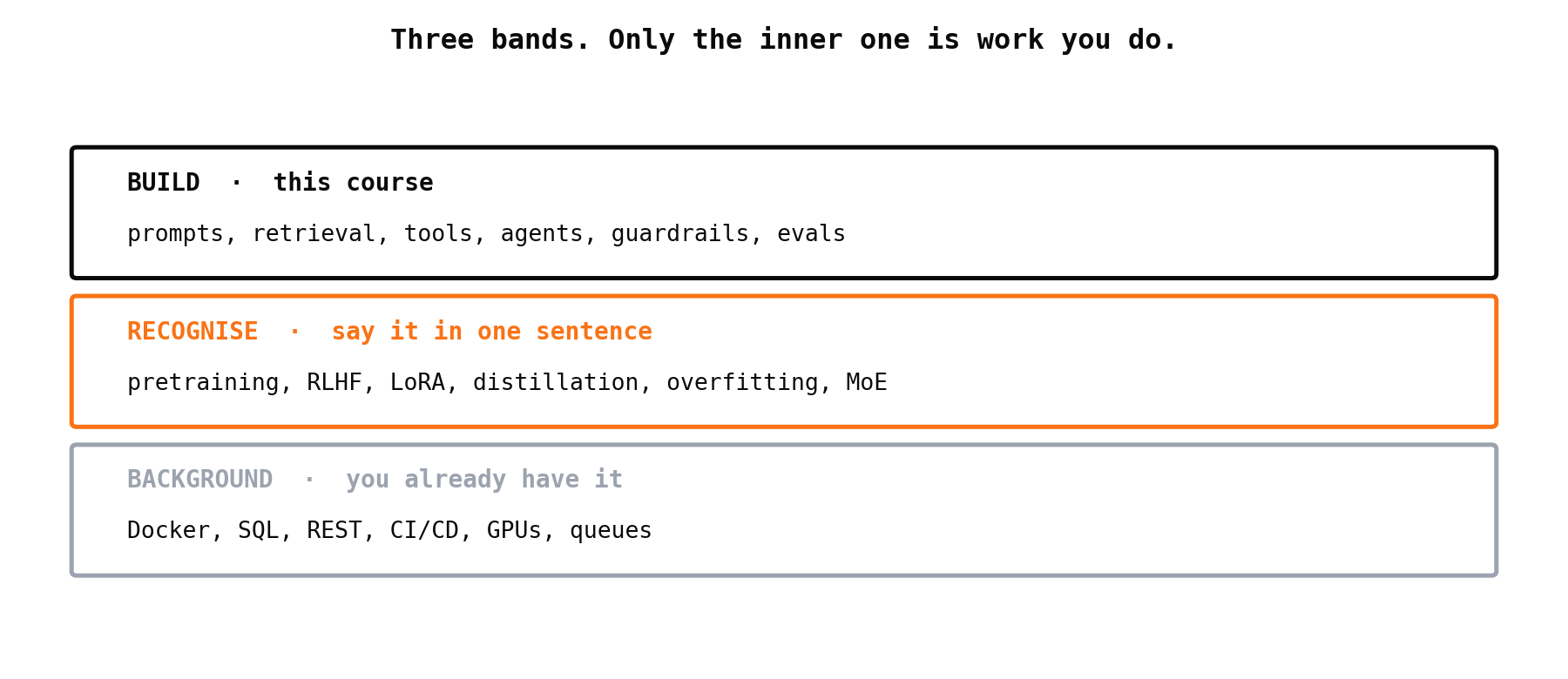
The inner band is what this course taught. The middle band is what you should be able to define in one sentence when it comes up. The outer band is background you already have as a programmer. Nothing below moves you inward, and that is the point.
Group One: How a Model Gets Made
This is everything that happens before an API key exists. You will not do any of it, and understanding it changes which model you pick and what you can reasonably expect from one.
| Term | What it means, and why you should recognise it |
|---|---|
| The first massive training pass over raw text, which teaches language and world knowledge. It is why a model already knows things before you touch it. | |
| Further training on a narrower dataset to specialise a model. The real alternative to retrieval when you need new behaviour rather than new facts. | |
| Fine-tuning on curated input and output pairs. The standard way a raw base model becomes a helpful assistant. | |
| A flavour of SFT that teaches a model to follow commands. It is the reason a model obeys your prompt at all. | |
| Reinforcement Learning from Human Feedback. Human preference signals used to shape behaviour, which is why models feel polite and aligned. | |
| Two algorithms for preference training. PPO is the classic reinforcement method, DPO is a simpler and now more common alternative. | |
| The umbrella idea behind both. Training toward outputs humans prefer, rather than only outputs that are correct. | |
| Cheap fine-tuning: train small add-on weights instead of the whole model. QLoRA adds quantization on top. This is why fine-tuning stopped being a data-centre activity. | |
| Parameter-Efficient Fine-Tuning, the family LoRA belongs to. | |
| A memory-saving trick during training that spends compute to save RAM. You meet it in stories about training big models on modest hardware. | |
| Training a small student model to imitate a large teacher. It is why a fast cheap model can punch above its size, and why the small model you like is often good at exactly what its teacher was good at. | |
| Shrinking a model by using lower-precision numbers, trading a little accuracy for large speed and memory wins. | |
| An architecture that routes each token through a few specialised sub-networks instead of the whole model. It is why some enormous models are still fast. |
Two of these deserve a second look, because they leak across the wall.
is the one you will actually be asked about, and the answer is already in this course. Retrieval teaches facts, fine-tuning teaches behaviour, and picking wrongly is expensive. That argument is made properly in Giving Models Your Knowledge, so it is not repeated here.
is the genuine crossover. It stops being vocabulary and starts being a decision the moment you run a model on your own hardware, because it is what decides whether the thing fits at all.
Group Two: The Field This One Grew Out Of
Classic machine learning is not obsolete and it is not what you are doing. These terms come from a world of training your own models on your own data, usually for prediction and classification rather than generation. You will hear them from data scientists, in older codebases, and in any interview where the company does both.
| Term | What it means |
|---|---|
| Supervised, unsupervised, reinforcement learning | The three classic paradigms: learning from labelled data, from unlabelled structure, and from reward. |
| A model memorising its training data instead of generalising. The canonical failure the whole field guards against. | |
| Techniques that discourage overfitting by penalising complexity. | |
| Splitting data repeatedly to check that a model generalises. | |
| Hand-crafting the input signals a model learns from. Mostly replaced by learned representations in deep learning. | |
| The balance between a model too simple to fit and one too sensitive to noise. | |
| Precision, recall, F1, ROC-AUC | The core metrics of classification quality. You hear them any time someone evaluates a non-generative model. |
| CNN, RNN, LSTM, GRU | Neural network families that came before the Transformer, for images and for sequences. Useful context for why Transformers won. |
| The architecture every modern LLM is built on. You met its behaviour in Level 1. Here it is named as a lineage. | |
| The algorithm pair by which networks learn from error. The engine under all training. | |
| The most common optimiser and its main dial, how fast a model updates while training. | |
| Two standard tricks that make deep networks train stably and generalise better. |
There is a reason this course skips the theory instead of teaching a thin version of it. A little training theory is worse than none, because it hands you a mechanism you cannot see or change, and you start explaining production failures with it. The model did not overfit to your prompt. Your retrieval returned the wrong chunk.
Group Three: The Engineering You Already Have
The third group is not AI at all. It is ordinary software and infrastructure vocabulary, listed because it is assumed rather than taught.
| Area | Terms |
|---|---|
| Languages and data | Python, NumPy, Pandas |
| ML frameworks | PyTorch, TensorFlow, JAX, all training-side and rarely touched on this path |
| Packaging and runtime | Docker, Kubernetes, containers, serverless |
| Delivery | CI and CD |
| Datastores and caching | SQL, NoSQL, PostgreSQL, Redis |
| Service design | REST APIs, WebSockets, queues, async processing, rate limiting, scalability |
| Cloud and hardware | AWS, Azure, Google Cloud, GPUs, CUDA, distributed training |
| Model lifecycle | Model serving, experiment tracking, drift, versioning, canary releases |
If you are here as a working programmer, you have most of this already. The parts that genuinely matter for running agents were pulled into Level 9 rather than left in a list, which is why serving, observability and deployment each got real treatment instead of a definition.
Knowing the Border Is Part of the Job
Go back to the wall. The point of this chapter is not that these words are unimportant. It is that they belong to a job that is not yours, and knowing exactly where your job stops is what makes you credible in a room with people doing the other one.
The engineer who cannot define RLHF looks like they skipped the reading. The engineer who claims they would apply RLHF to their agent looks worse, because now the mistake is confident. The right answer is short: that happens when the model is made, and it shapes which model I choose, not something I run.
You build the rings. Someone else built the centre. Say so plainly, and you will sound like the only person in the room who knows which is which.