Enterprise EKS MLOps Platform Development & Advanced Model Orchestration
A Self-Hosted MLOps Platform on Kubernetes
A ride-hailing company's data scientists needed to run the full model lifecycle, notebooks, pipelines, experiment tracking, and a model registry, without sending data to a third-party service. I built a self-hosted MLOps platform on AWS: infrastructure as code that provisions a Kubernetes cluster, then deploys Charmed Kubeflow and Charmed MLflow onto it with an operator framework, wired together behind one dashboard. It is reproducible and runs entirely inside their own AWS account.
The problem
A data team was doing machine learning without a shared platform. Training ran on people's machines, experiments were not tracked, and there was no repeatable path from a notebook to a managed model. They wanted the standard open-source tools, Kubeflow for pipelines and notebooks and MLflow for tracking and the registry, but running on their own infrastructure. A hosted SaaS was ruled out because the data had to stay in their AWS account. Installing these tools by hand is where teams get stuck: Kubeflow is a large bundle that needs persistent storage, an ingress, and authentication, all wired together. They needed it stood up in a repeatable way, not a one-off manual install nobody could reproduce.
Constraints
- ·Self-hosted in the client's own AWS account, so a managed ML service was ruled out.
- ·Kubernetes-based, because Kubeflow and MLflow run on Kubernetes and need storage, ingress, and auth.
- ·Reproducible: the cluster and platform had to rebuild from code, not be clicked together once.
- ·Built by a single engineer, so the moving parts had to stay manageable.
Architecture
Infrastructure as code (Terraform modules for VPC, EKS, and a bastion, or an eksctl config) provisions an AWS EKS cluster named `kubeflow` with OIDC enabled and the AWS EBS CSI driver for persistent volumes. Juju registers the cluster, bootstraps a controller onto it, and deploys Charmed Kubeflow (pipelines, notebooks, Katib, an Istio ingress, and Dex auth) and Charmed MLflow (tracking, registry, MinIO artifact store). MLflow is integrated into the Kubeflow ingress and dashboard, so the two open-source tools appear as one platform behind a single login.
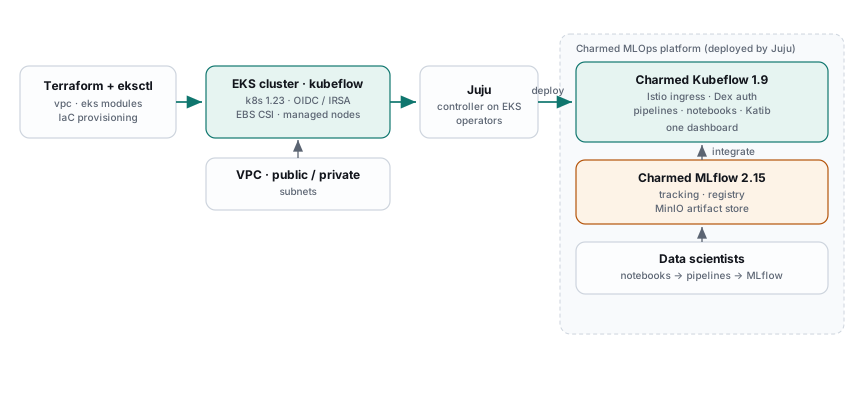
- ›Terraform modules: VPC and EKS composed in main.tf (bastion and ALB modules exist in the repo but are not wired in)
- ›eksctl ClusterConfig (eks.yaml): EKS `kubeflow`, k8s 1.23, managed Ubuntu node group, OIDC
- ›AWS EBS CSI driver as an EKS addon, permissions via an IRSA role bound through OIDC
- ›Juju operator framework: controller bootstrapped on the EKS cluster
- ›Charmed Kubeflow 1.9: Istio ingress, Dex auth, pipelines, notebooks, Katib
- ›Charmed MLflow 2.15: experiment tracking, model registry, MinIO artifact store
- ›Integration relations that put MLflow behind the Kubeflow ingress and dashboard
How one request flows
- 01Provision the cluster from code: Terraform modules or an eksctl config create an EKS cluster named `kubeflow` with a managed node group and OIDC on.
- 02Wire storage and identity: install the AWS EBS CSI driver as an addon for persistent volumes, with permissions from a scoped IAM role bound to a service account through OIDC, not from broad node permissions.
- 03Bring in the operator framework: Juju registers the cluster, bootstraps a controller, and creates a model for the platform.
- 04Deploy Kubeflow as a bundle: one command deploys pipelines, notebooks, Katib, an Istio ingress, and Dex auth, managed by operators rather than raw manifests.
- 05Deploy MLflow and connect it: Charmed MLflow with MinIO as its artifact store, then integrated into the Kubeflow ingress and dashboard.
- 06Hand it over: data scientists log in through the dashboard, work in notebooks, run pipelines, and track runs and models in MLflow. Teardown is a documented pair of commands.
Engineering decisions
Operators instead of hand-written YAML
What. Deployed Kubeflow with Juju and the Charmed bundles rather than applying raw manifests.
Why. Kubeflow is dozens of services that must stay in sync, and described as an operator-managed model the platform is not YAML someone has to babysit.
Tradeoff. A less common toolchain with some beta-era rough edges at the time, worth it for a bundle this size.
Permissions scoped through OIDC, not the node
What. Enabled OIDC and bound a narrow IAM role to the storage driver's service account.
Why. Attaching permissions to the nodes hands every pod the same access, while per-service-account roles grant only what a component needs.
Tradeoff. One extra setup step, taken to avoid over-granting by default.
Two tools, one front door
What. Integrated MLflow into Kubeflow's ingress and dashboard as a declared relation.
Why. A data scientist sees one platform and one login, and a notebook already has its MLflow and storage connection.
Tradeoff. None significant. The relation is declared, not glued by hand.
Reproducible, not a one-off
What. Cluster from code (Terraform or eksctl) and a platform deploy from pinned commands, with a documented teardown.
Why. The runbook takes an empty AWS account to a working platform and back, so anyone can rebuild it.
Tradeoff. More up-front discipline than a manual install, which is the point.
What changed along the way
- →Started with a local Kubernetes (microk8s) and Juju to learn the deployment, then moved onto EKS for a real shared cluster.
- →Kept two ways to make the cluster, reusable Terraform modules and an eksctl config, since each suited a different moment.
- →Worked through Juju version churn during setup and settled on pinned charm channels so the deploy is repeatable.
Security and reliability
- ·Scoped identity: OIDC plus IAM roles for service accounts, so components get only the AWS permissions they need.
- ·Private networking: a VPC with public and private subnets, so workloads are not exposed to the internet by default.
- ·Authentication: Dex guards the Kubeflow dashboard behind a login.
- ·Persistent state: the EBS CSI driver backs the platform's volumes and MinIO holds MLflow's artifacts.
- ·Rebuildable: cluster and platform are code, so recovery is a rebuild and teardown is documented.
Metrics
What shipped
- ✓Delivered a working self-hosted MLOps platform: Charmed Kubeflow and Charmed MLflow on AWS EKS, integrated behind one dashboard and login.
- ✓Data scientists get notebooks, pipelines, experiment tracking, and a model registry without leaving the company's AWS account.
- ✓The cluster and platform rebuild from code and pinned versions, and tear down cleanly.
- ✓Persistent storage and artifact storage handled by the EBS CSI driver and MinIO, with scoped IAM throughout.
- ✓A runbook that takes an empty AWS account to a running platform.
Lessons learned
- ·For a platform the size of Kubeflow, an operator framework beats hand-written manifests, because something has to own the lifecycle.
- ·OIDC with per-service-account IAM roles is the right default for cluster permissions, not node-wide grants.
- ·Pinning charm channels is what makes a Kubernetes platform actually reproducible.
- ·Self-hosting the MLOps stack keeps the data in the client's account, which was the whole reason to avoid a SaaS.